
Life on the land around Rockhampton has its own soundtrack. The low idle of a diesel ute at a set of yards before sunrise, the whine of an angle grinder in a shed, the steady roar of a header working through the dry season. This article is a general-interest look at the loud side of rural Central Queensland, written as awareness and background rather than as guidance for any individual.
A Region That Makes a Fair Bit of Noise
Central Queensland is a working region. Cattle properties, cropping country, mines, engineering workshops and the rail corridor all sit within a short drive of the Fitzroy River, and a fair amount of sound moves around the district in any month.
Rural life also blurs the line between work and recreation: the same shed holds the tools for a paid job on Friday and the hobby project on Saturday.
How Loud Sound Is Described
Sound is usually described in decibels. Because the scale is logarithmic, a small jump in the number represents a much larger change in sound energy than most people expect.
Safe Work Australia sets a national exposure standard for noise in the model work health and safety laws. It is expressed in two parts: an average level of 85 decibels A-weighted over an eight hour working day, and a peak level of 140 decibels C-weighted. Those are regulatory reference points for workplaces, quoted here as published fact.
Steady Sound and Sudden Sound
Acousticians often separate continuous sound from impulse sound. Continuous sound is the drone of a tractor cab, a pump, a grain auger or a compressor, carrying on for hours. Impulse sound is the opposite: extremely brief and extremely intense. A hammer striking steel or a post driver dropping are the everyday rural examples.
That difference is why the noise standard has two numbers rather than one. An average over a shift describes machinery well but misses a single sharp event. National Acoustic Laboratories, the research arm associated with Hearing Australia, has published on how noise exposure is measured here.
Harvest, Headers and the Machinery Season
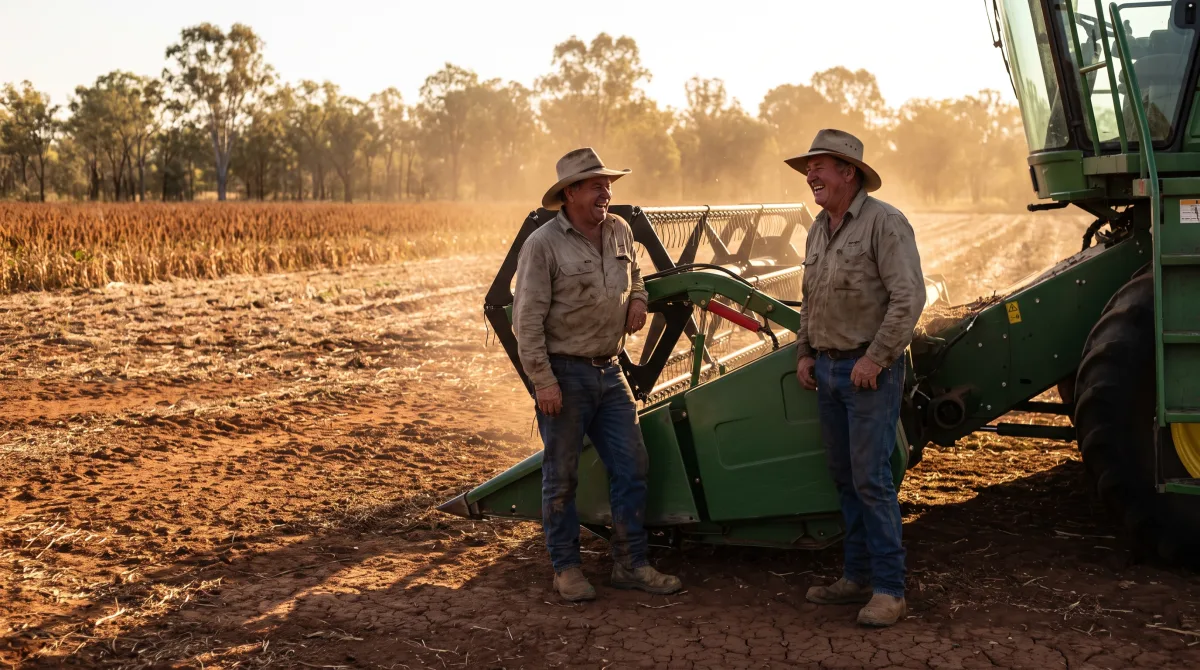
Harvest is the stretch of the year when machinery noise runs longest. A header working a sorghum or chickpea block can be going before breakfast and still going after dark: the engine, the threshing drum, the fan, the chaser bin tractor alongside. Grain augers and field bins add their own drone at the silo.
The rest of the calendar brings its own machinery, from tractors on a slasher through the wet season regrowth to irrigation pumps in a paddock corner. Many modern cabs are enclosed and quieter than the open tractors of a generation ago, so the sound picture on a property today differs from the one older operators knew.
Cattle Yards, Saleyards and Road Trains
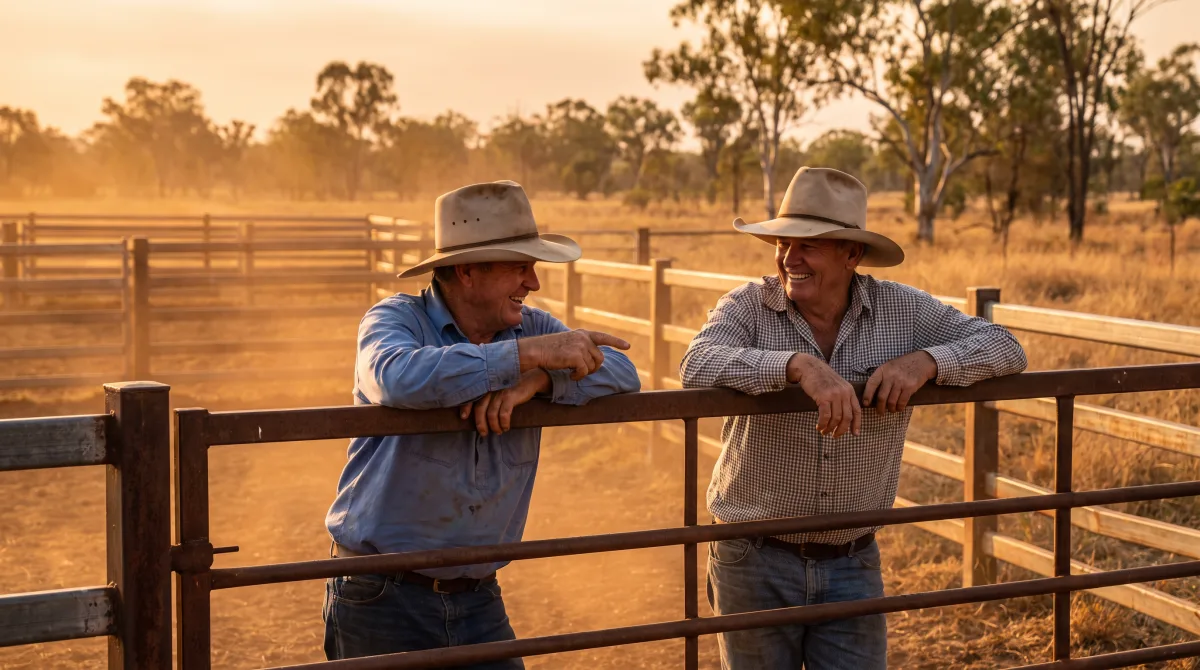
Stock work has a sound all of its own. A drafting session runs on clanging steel gates, a rattling crush, bellowing cattle and a fair bit of shouting over the top, and a saleyard on sale day gathers all of it into one place. Trucks are the other regional constant: road trains rolling in and out of properties, traffic on the Bruce and Capricorn Highways, compression braking coming down a grade. Mining and industrial plant around Rockhampton and Gracemere keeps that hum going around the clock in places.
The Shed and the Home Workshop
Away from the paddock, the loud moments cluster in the shed. Chainsaws during clearing after a wet season. Grinders and welders on a repair job. Air compressors, impact wrenches, drop saws, and the Saturday mower.
A common question is simply what the different hearing protection products actually are. Broadly, the equipment divides into a few familiar categories. Earplugs sit in the ear canal and come in disposable foam, reusable and custom moulded forms. Earmuffs sit over the whole outer ear in a cup. Electronic or level dependent muffs contain circuitry that passes through quieter sounds such as conversation while limiting louder ones. In Australia, hearing protectors are covered by an Australian and New Zealand Standard and are rated so their performance can be compared. That is a description of the product landscape, not a recommendation.
Workplace Health and Safety Queensland and Safe Work Australia both note that noise is a recognised hazard under work health and safety law, with obligations sitting on the business rather than the individual worker. That side of the subject is covered in our general piece on hearing at work in Australia. On a family property, plenty of the noisiest jobs happen outside any formal workplace arrangement.
Why It Comes Up in Conversation
Many people here find that sound is simply part of the job. Others become curious once they notice how quiet the house feels after a long day near machinery. Hearing Australia publishes general information for the public about noise and hearing, and the event side of the subject is covered in our earlier piece on hearing protection at the Rockhampton Show, rodeos and motorsport events.
The point of an awareness piece is not to tell anyone what to do. It is just to notice something we take for granted: the country around Rockhampton is a loud place to live and work, and the header, the shed and the yards on drafting day are all part of the same story.
If you'd like to chat about your hearing, the friendly team at CQ Audiology in Rockhampton is here to help. Call (07) 4848 6528 or book online.
Sources: Safe Work Australia (model WHS laws, exposure standard for noise); Workplace Health and Safety Queensland (noise as a workplace hazard); National Acoustic Laboratories (noise measurement research); Hearing Australia (general public information on noise and hearing); AS/NZS standard for hearing protectors.
Concerned about your hearing?
Book a comprehensive assessment with our Rockhampton clinic.
Book an Appointment