
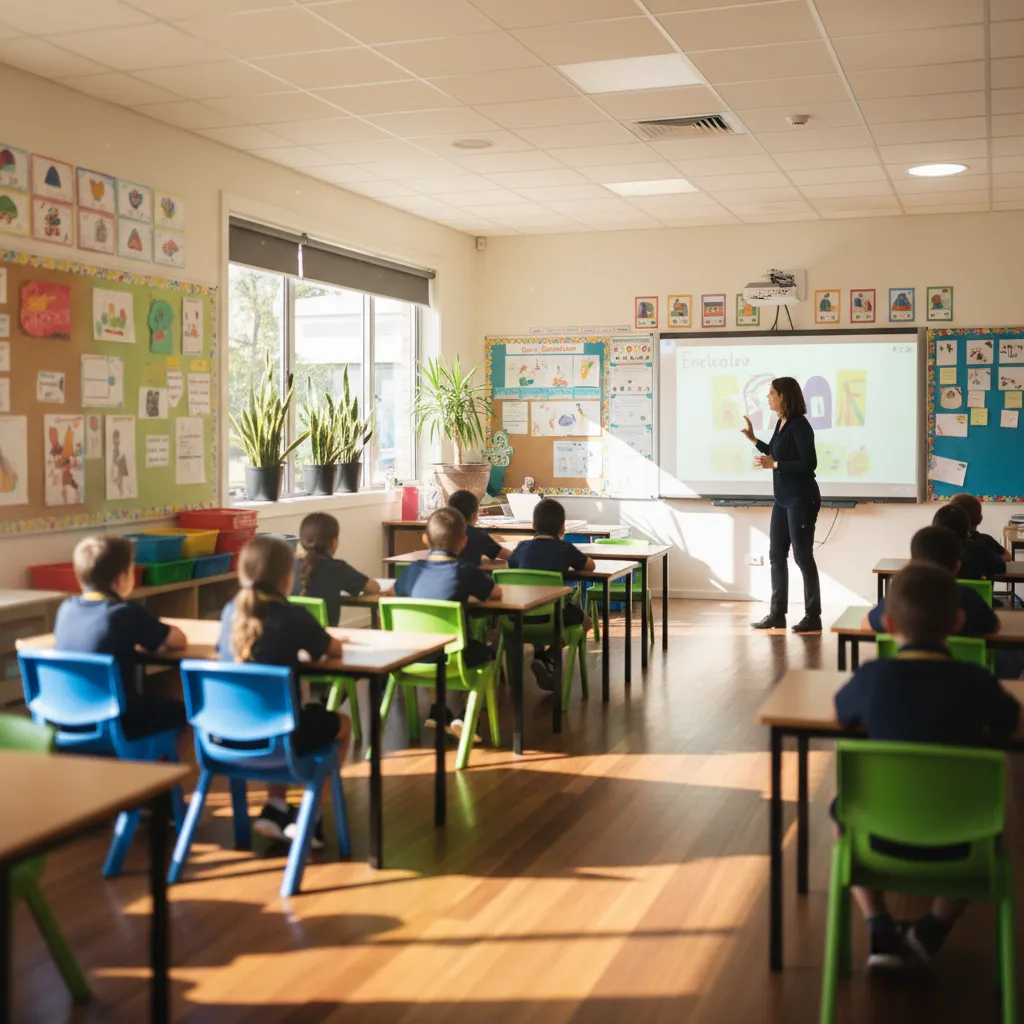
School is a listening environment. From the moment a child walks into a classroom, they are expected to follow verbal instructions, process spoken explanations, participate in discussions, and absorb information delivered largely through sound.
For a child with any degree of hearing difficulty, this environment presents a set of challenges that are not always visible, and not always recognised for what they are.
The Hidden Effort of Listening in a Noisy Classroom
A typical classroom is not a quiet space. Background noise from air conditioning, outdoor areas, corridors, movement, and the combined sounds of a roomful of children creates a listening environment that is challenging even for people with typical hearing.
For a child with hearing difficulty, the effort required to decode speech in background noise can be significantly greater than for their peers. Researchers call this phenomenon "listening effort," and its effects extend well beyond the moment of trying to hear.
Research suggests that children with hearing loss may expend more listening effort to understand speech in noise than children with typical hearing. This additional listening effort can reduce the mental resources available for tasks that require higher thinking, such as understanding new concepts, storing information, generating answers, and staying engaged.
The result can look like inattention, slowness, or difficulty with comprehension, none of which accurately describes what is actually happening.
Effects on Literacy
The relationship between hearing and literacy development is well established in research.
Learning to read requires a child to connect written symbols (letters) with the sounds they represent. This process, known as phonological awareness, depends on having a clear and accurate internal map of speech sounds. When hearing is reduced, the sounds of speech may be less distinct, and the foundation for phonological awareness can be affected.
Research by Moeller et al. (2010, Ear and Hearing) found that children with mild to moderate hearing loss that was identified later often showed differences in phonological processing compared with peers with typical hearing.
This does not mean that a child with hearing loss cannot become a confident reader, many do, particularly with appropriate support. It does mean that unexplained reading difficulty is worth exploring, and hearing is one of the factors worth checking.
Taking Part in Class and the Playground
Hearing can also shape how a child takes part in the classroom and playground.
Children who frequently misunderstand instructions, miss jokes, or lose the thread of group conversations can find it harder to keep pace with fast-moving classroom and playground conversations. Helping a child hear clearly, and giving them simple strategies to ask for repetition or clarification, can support their participation in group activities and discussions.
This is particularly relevant in CQ schools, where class sizes and acoustic conditions can vary significantly, from well-resourced Rockhampton schools to smaller regional classrooms in Emerald and the surrounding areas, where ambient noise levels and classroom layouts may present additional challenges.
FM Systems in Queensland Schools
A Frequency Modulation (FM) system, sometimes called a sound field system, involves a small microphone worn by the teacher and a receiver that delivers the teacher's voice directly to the child's hearing device or via a speaker in the room.
FM systems can improve the signal-to-noise ratio for the child, meaning the teacher's voice is clearer relative to the background noise. Research into FM system use in educational settings has found associations between FM use and improved speech recognition for children with hearing loss, though individual outcomes depend on factors including the child's hearing profile, the classroom environment, and how consistently the system is used.
In Queensland, access to FM systems and other assistive technology in schools is typically coordinated through Queensland Health, Hearing Australia, and the school's special education support team. A diagnosis and audiologist report are generally required as part of this process.
Frequently Asked Questions
Q: My child's school says they passed a hearing check. Why am I still concerned? School hearing checks are typically brief and do not test all aspects of hearing. They may miss mild hearing difficulties, frequency-specific losses, or issues with hearing in background noise. If you have ongoing concerns after a school screen, a full audiological assessment provides a more comprehensive picture.
Q: Can a child with mild hearing loss really struggle significantly at school? Yes. Research consistently shows that even mild hearing loss can affect listening effort, language development, phonological awareness, and classroom participation. The degree of functional impact depends on many factors, including classroom acoustics, teaching style, and the individual child. A mild loss in a challenging acoustic environment can have a more significant day-to-day impact than the audiogram alone might suggest.
Q: How do I know if my child needs an FM system? FM systems are typically considered when a child has a diagnosed hearing loss and the classroom environment presents significant listening challenges. An audiologist can advise on whether an FM system is likely to be beneficial based on your child's hearing profile and circumstances, and can prepare the documentation needed to access one through the school system.
Q: My child has been diagnosed with hearing loss. Will they always need extra support at school? This varies considerably depending on the degree and type of hearing loss, whether hearing technology is worn consistently, and the individual child. Many children with hearing loss participate fully in mainstream classrooms with appropriate support. An audiologist and, if relevant, a teacher of the deaf can help develop a support plan that is reviewed and updated as your child progresses.
Concerned about your hearing?
Book a comprehensive assessment with our Rockhampton clinic.
Book an Appointment